


-
Llámanos : +86 13728718457
-
Envíanos un correo electrónico : Lexie@Sharicca.com
Llámanos : +86 13728718457
Envíanos un correo electrónico : Lexie@Sharicca.com

Introducción
La mayoría de la gente piensa que la ropa interior menstrual funciona de una manera sencilla:
El tejido absorbe el flujo menstrual.
Pero la respuesta real es más compleja.
Una braguita menstrual de alto rendimiento no se fabrica simplemente añadiendo más material absorbente. Está diseñada como un sistema completo donde diferentes capas trabajan juntas para gestionar el flujo menstrual.
Por eso, dos productos de ropa interior menstrual con índices de absorción similares pueden tener un rendimiento diferente en situaciones reales.
La diferencia no radica únicamente en la cantidad de líquido que puede absorber un producto. También influye la rapidez con la que el líquido se desplaza, la eficacia con la que se extiende, su capacidad para permanecer dentro de la estructura y el ajuste de la prenda al cuerpo.
Desde un Fabricación OEM de ropa interior menstrual Desde esta perspectiva, desarrollar ropa interior menstrual fiable requiere un equilibrio entre el rendimiento del tejido y la confección de la prenda.
El objetivo no es simplemente crear un producto con mayor capacidad de absorción.
El objetivo es crear un producto que gestione eficazmente el flujo menstrual, a la vez que sea cómodo, flexible y apto para el uso diario.
¿Cómo funciona la ropa interior menstrual?
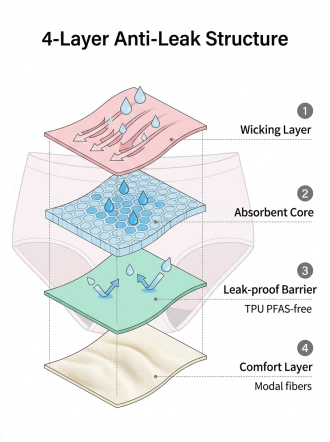
A diferencia de la ropa interior normal, la ropa interior menstrual está diseñada para controlar el movimiento del flujo menstrual a través de múltiples capas funcionales.
El proceso se puede explicar en cuatro pasos:
Transferir → Absorber → Retener → Proteger
1. Transfer
El primer paso es alejar el líquido de la piel.
Una capa interior de tejido adecuada ayuda a conducir la humedad hacia la zona absorbente, reduciendo la incómoda sensación de humedad durante su uso.
2. Absorb
La capa absorbente recibe el líquido y lo distribuye por toda la zona funcional.
Una buena estructura impide que el líquido permanezca concentrado en un punto pequeño.
3. Conservar
El sistema absorbente debe retener el líquido de forma segura dentro de la estructura de la prenda.
Esto depende de la selección de la tela, la densidad y la confección.
4. Proteger
La barrera impermeable ayuda a evitar que el líquido llegue al tejido exterior.
En conjunto, estas funciones crean el sistema de gestión de líquidos que permite el buen funcionamiento de la ropa interior menstrual.
La estructura de cuatro capas que garantiza el rendimiento de la ropa interior menstrual
La confección típica de ropa interior menstrual incluye varias capas funcionales.
La estructura exacta puede variar dependiendo de:
Una estructura de uso común incluye:
Cada capa tiene una responsabilidad diferente.
El buen rendimiento depende de cómo estas capas trabajen juntas.
1. Capa interior de tejido (capa en contacto con la piel)
Eliminar el líquido de la piel
La primera capa, compuesta de tejido, ayuda a transferir el líquido lejos de la piel y lo guía hacia la capa absorbente que se encuentra debajo.
Esta función es importante porque la comodidad depende no solo de la capacidad de absorción, sino también de la rapidez con que la humedad abandona la superficie de la piel.
2. Capa absorbente y de secado rápido
Controlar la velocidad y la capacidad de absorción.
La capa absorbente y de transpiración es la zona funcional principal de la ropa interior menstrual.
Su propósito es:
Dos factores de rendimiento son especialmente importantes durante el desarrollo del producto.
1. Velocidad de absorción
¿Con qué rapidez puede el líquido alejarse de la piel?
La rápida transferencia de líquidos contribuye a mejorar la comodidad y reduce la sensación de humedad durante su uso.
2. Capacidad de absorción
¿Cuánto líquido puede contener la estructura?
La capacidad de absorción se mide habitualmente por volumen de líquido y se expresa en mililitros (ml).
Sin embargo, la capacidad de absorción por sí sola no define la experiencia de uso completa.
Un producto con alta capacidad aún puede presentar problemas si:
Por eso Fabricantes experimentados de ropa interior menstrual evaluar la velocidad y la capacidad de absorción conjuntamente.
3. Capa de barrera impermeable de TPU
Evitar fugas manteniendo la comodidad
La capa barrera impermeable de TPU está diseñada para evitar que el flujo menstrual atraviese la prenda.
Una vez que el líquido se transfiere y es absorbido por las capas funcionales, la capa barrera ayuda a mantener la humedad dentro de la estructura y protege el tejido exterior.
La ropa interior menstrual se lleva pegada al cuerpo durante muchas horas. Por lo tanto, la capa protectora debe brindar protección sin que la prenda resulte rígida o incómoda.
Por ello, la capa impermeable siempre debe desarrollarse como parte de la estructura completa de la prenda, en lugar de tratarse como un componente impermeable independiente.
Una buena ropa interior menstrual no se consigue reforzando una sola capa.
Se crea haciendo que todas las capas funcionen en conjunto.
4. Capa exterior de tela
Creando comodidad y una experiencia de uso seca.
El tejido exterior es la capa que los consumidores ven y sienten durante el uso diario.
Si bien no gestiona directamente el flujo menstrual, desempeña un papel importante en el rendimiento general del producto.
El tejido exterior debe proporcionar:
Comodidad al contacto con el cuerpo; elasticidad adecuada; durabilidad tras el lavado; aspecto agradable.
Las opciones de tela más comunes pueden incluir:
Una expectativa importante por parte de los consumidores es que el exterior de la prenda permanezca seco.
Esto significa que el líquido debe permanecer controlado dentro de las capas funcionales en lugar de penetrar hacia el exterior.
Por qué las pruebas de absorción de laboratorio y los resultados de uso en la vida real pueden ser diferentes.
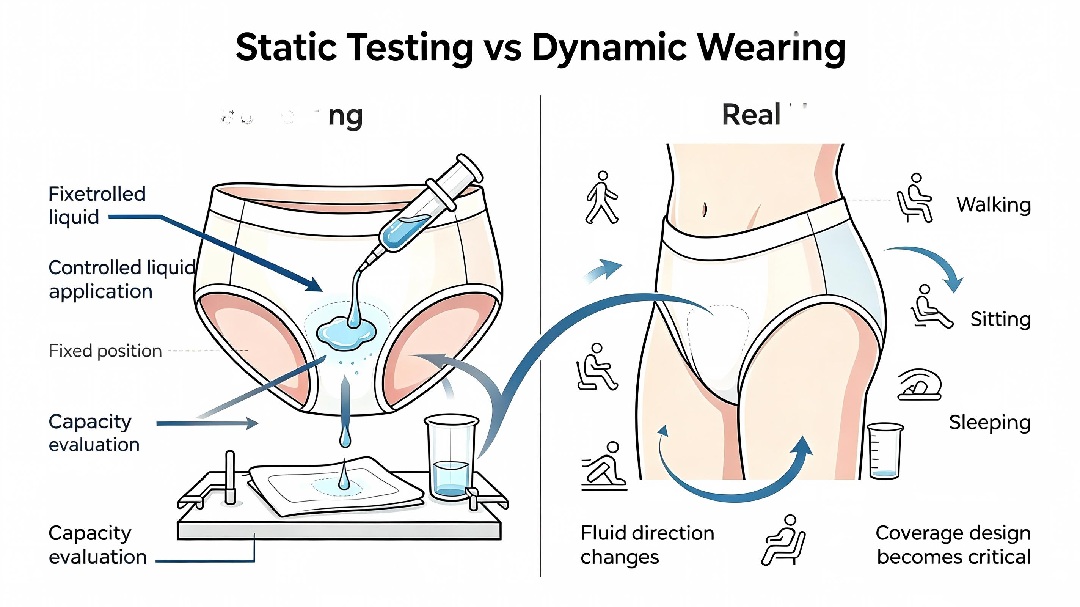
Las pruebas de absorción son una parte importante del desarrollo de la ropa interior menstrual.
Los fabricantes suelen evaluar el rendimiento mediante métodos de prueba controlados, incluida la capacidad de absorción de líquidos medida en mililitros (ml).
Estas pruebas ayudan a comparar diferentes productos y a confirmar si la estructura cumple con los requisitos de desarrollo.
Sin embargo, los resultados de laboratorio no siempre representan todas las situaciones de uso en la vida real.
¿Por qué?
Porque las consumidoras no usan ropa interior menstrual en un entorno de prueba controlado.
Durante el uso diario, la prenda experimenta:
Por ejemplo, un producto puede mostrar una buena capacidad de absorción en una prueba de laboratorio, pero el consumidor aún puede experimentar fugas si el líquido no se distribuye de manera eficiente a través del área funcional.
Por eso, el desarrollo de productos no puede centrarse únicamente en la cantidad de mililitros.
Una mejor evaluación considera:
Capacidad de absorción + Velocidad de secado + Diseño de cobertura + Ajuste de la prenda
Perspectiva del fabricante
Según la experiencia en el desarrollo de productos, muchas mejoras no provienen de añadir más material absorbente, sino de mejorar la estructura general.
Por ejemplo, los comentarios de los clientes a menudo se centran en la cobertura insuficiente.
Mucha gente piensa inicialmente que la cobertura de la espalda es el principal problema.
Sin embargo, durante el desarrollo, a menudo observamos que mejorar la zona de cobertura frontal también puede ayudar a reducir el riesgo de fugas.
Es necesario considerar cuidadosamente el panel frontal y la zona del fuelle, ya que el movimiento de los líquidos no siempre es predecible durante el uso en la vida real.
En ocasiones, un mejor diseño del patrón puede mejorar la protección de forma más eficaz que simplemente aumentar el grosor del material absorbente.
Cómo los fabricantes diseñan diferentes niveles de absorción para la ropa interior menstrual.
A diferencia de los productos menstruales desechables, que suelen clasificarse como versiones de "día" o de "noche", la ropa interior menstrual se suele diseñar en función de las diferentes necesidades de flujo.
Las consumidoras eligen los productos en función del nivel de flujo menstrual que esperan experimentar.
Durante el desarrollo del producto, los fabricantes ajustan la estructura según el nivel de protección requerido.
Ropa interior menstrual de flujo bajo
Para requisitos de flujo más ligeros, los fabricantes pueden centrarse en:
capas funcionales más ligeras;
construcción de perfil más bajo;
comodidad diaria;
flexibilidad.
La zona funcional puede diseñarse con una altura de capa reducida para conseguir una sensación más fina y cómoda.
Ropa interior menstrual de alto flujo
Para requisitos de flujo más intensos, los fabricantes pueden aumentar la protección ajustando:
tamaño del área absorbente;
área de cobertura;
estructura de capas;
Diseño de la cinturilla y del panel frontal.
El objetivo no es simplemente hacer la prenda más gruesa.
Un producto más grueso puede afectar la comodidad y la aceptación del consumidor.
La mejor solución consiste en crear una estructura eficiente donde el líquido pueda moverse, extenderse y mantenerse bajo control.
Cómo la selección de la tela afecta el rendimiento de la ropa interior menstrual
La selección de la tela es uno de los pasos más importantes a la hora de desarrollar ropa interior menstrual de marca propia.
No existe un único tejido que sea el "mejor".
La elección correcta depende de cómo se comporta el tejido dentro de la estructura completa de la prenda.
Un tejido que resulta cómodo pero que no permite el paso de líquidos puede no ofrecer el mejor rendimiento.
Selección de tejido interior
El tejido que está en contacto con la piel debe proporcionar:
Un tejido que resulta cómodo pero que no permite el paso de líquidos puede no ofrecer el mejor rendimiento.
La capa absorbente depende de:
Los diferentes materiales pueden generar resultados distintos dependiendo de su estructura.
La tela exterior influye en:
Para marcas en desarrollo ropa interior menstrual de marca propiaLa selección de la tela siempre debe considerarse junto con el diseño del patrón y la capacidad de producción.
Un material que funciona bien por sí solo puede no lograr el resultado deseado cuando se combina con otras capas.
Errores comunes que cometen las marcas al desarrollar ropa interior menstrual
El diseño de ropa interior menstrual es diferente al de ropa interior común.
Muchos problemas surgen porque las marcas se centran en un único aspecto del rendimiento, pasando por alto el sistema de producto en su conjunto.
Aquí tienes algunos errores comunes de desarrollo.
1. Centrarse únicamente en la capacidad de absorción
Una suposición común es:
Mayor capacidad de absorción significa mejor protección.
Sin embargo, el rendimiento real depende de algo más que la cantidad de líquido que la prenda pueda absorber.
Un producto también necesita:
Un producto de mayor capacidad puede no funcionar correctamente si el líquido permanece estancado en una zona o no se mueve de manera eficiente a través de la estructura.
2. Añadir más capas sin tener en cuenta la comodidad.
Aumentar el número o el grosor de las capas puede mejorar ciertos resultados de las pruebas.
Sin embargo, las consumidoras también esperan que la ropa interior menstrual tenga una textura similar a la ropa interior normal.
Un diseño demasiado voluminoso puede afectar la flexibilidad de movimiento, la apariencia debajo de la ropa y la comodidad diaria.
El mejor producto no es necesariamente el más grueso.
Es aquella en la que los materiales y la construcción están en perfecto equilibrio.
3. Ignorar el diseño de patrones y cobertura
La ropa interior menstrual sigue siendo una prenda de vestir.
La tecnología textil por sí sola no puede resolver todos los problemas.
El diseño del patrón afecta a:
Durante el desarrollo, las marcas deben evaluar tanto el rendimiento del tejido como la confección de la prenda.
4. Desarrollar sin comprender el mercado objetivo.
Los distintos mercados pueden tener expectativas diferentes.
Los consumidores pueden diferir en:
Por ejemplo, algunos mercados pueden preferir estilos más suaves y ligeros para el día a día, mientras que otros pueden priorizar una mayor protección y una cobertura más amplia.
Un fabricante de ropa interior menstrual OEM exitoso debe ayudar a las marcas a conectar el diseño del producto con las necesidades del consumidor.
Desarrollo de ropa interior menstrual OEM: del concepto a la producción.
Para crear una colección exitosa de ropa interior menstrual de marca propia se necesita algo más que seleccionar un producto existente y añadirle un logotipo.
El proceso de desarrollo suele implicar varias decisiones importantes.
1. Definir la posición del producto.
Antes de que comience la producción, las marcas deben aclarar lo siguiente:
Una dirección clara del producto ayuda a determinar la construcción más adecuada.
2. Desarrollar la estructura adecuada
Los fabricantes evalúan:
El objetivo es crear una estructura que se ajuste al propósito del producto.
3. Muestreo y ajuste
Las muestras permiten a las marcas y a los fabricantes evaluar:
El desarrollo de productos a menudo requiere ajustes basados en pruebas y comentarios.
Pequeños cambios en el diseño, la combinación de tejidos o la zona funcional pueden afectar significativamente a la experiencia de uso final.
4. Producción en masa y control de calidad
Una vez aprobado el producto, la uniformidad en la producción se vuelve esencial.
El control de calidad debe abarcar:
Para las marcas que trabajan con un fabricante de ropa interior menstrual OEM, la capacidad de producción es solo una parte de la colaboración.
Comprender el desarrollo del producto es igualmente importante.
Preguntas frecuentes: Desarrollo y rendimiento de la ropa interior menstrual
¿Cómo absorbe la ropa interior menstrual el flujo menstrual?
La ropa interior menstrual absorbe el flujo menstrual gracias a su estructura multicapa.
La capa interior de tejido ayuda a alejar el líquido de la piel. La capa absorbente y transpirable lo retiene y distribuye. La barrera de TPU ayuda a prevenir fugas, mientras que el tejido exterior proporciona comodidad.
El resultado final depende de cómo interactúen estas capas.
2. ¿Cuántas capas suele tener la ropa interior menstrual?
Muchos productos de ropa interior menstrual de alto rendimiento utilizan una estructura de cuatro capas:
Sin embargo, el número de capas por sí solo no determina la calidad.
La selección de materiales, la confección y el diseño de la prenda influyen en el rendimiento.
3. ¿Una mayor capacidad de absorción significa que la ropa interior menstrual es mejor?
No siempre.
La capacidad de absorción es solo una parte del rendimiento del producto.
Un buen producto de ropa interior menstrual también requiere:
4. ¿Por qué pueden tener fugas las prendas de ropa interior menstrual incluso con alta absorción?
Las fugas pueden producirse por varias razones:
Por eso, el desarrollo de productos debe tener en cuenta tanto los materiales como la ingeniería de las prendas.
5. ¿Cómo se mide la capacidad de absorción de la ropa interior menstrual?
La capacidad de absorción se suele medir por volumen de líquido y se expresa en mililitros (ml).
Las pruebas de laboratorio proporcionan datos de rendimiento útiles.
Sin embargo, el uso en la vida real implica movimiento y presión corporal, por lo que los resultados de las pruebas siempre deben evaluarse junto con la experiencia de uso real.
6. ¿Qué deben tener en cuenta las marcas al desarrollar ropa interior menstrual de marca propia?
Las marcas deberían tener en cuenta lo siguiente:
Elegir un fabricante de ropa interior menstrual con experiencia puede ayudar a las marcas a desarrollar productos que equilibren el rendimiento, la comodidad y las exigencias del mercado.
7. ¿Cómo desarrollan las marcas sus propias líneas de ropa interior menstrual?
El desarrollo de ropa interior menstrual de marca propia suele implicar algo más que seleccionar un producto existente y añadirle el logotipo de la marca.
Una colección exitosa comienza por comprender el mercado objetivo, las necesidades del consumidor y el rendimiento esperado del producto.
El proceso de desarrollo normalmente incluye varios pasos clave:
1. Definir la posición del producto.
Las marcas primero deben determinar:
Estas decisiones influyen en la estructura general del producto.
Perspectiva de ingeniería final
El rendimiento de la ropa interior menstrual no se logra con un tejido especial ni con una sola tecnología.
Proviene de la combinación de:
Selección de materiales⇓
Estructura de gestión de líquidos⇓
Confección de prendas⇓
Experiencia de uso del consumidor
Los mejores productos se desarrollan cuando cada decisión respalda el mismo objetivo:
Transportar líquidos de forma eficiente, evitar fugas y crear una prenda cómoda en la que los consumidores confíen.
Para las marcas que se adentran en el mercado de la ropa interior menstrual, elegir al socio de fabricación adecuado no se trata solo de la capacidad de producción.
Se trata de trabajar con un socio que comprenda cómo se combinan los materiales, la construcción y el rendimiento en la vida real.
Si busca un fabricante experimentado de ropa interior menstrual para producción OEM o de marca propia, estaremos encantados de hablar sobre sus requisitos de producto.
Nuestro equipo de desarrollo ayuda a las marcas con la selección de tejidos, la confección funcional, el muestreo y la producción.
📩 Correo electrónico: Lexie@Sharicca.com
🌐 Sitio web: www.chuangrongapparel.com