


-
Llámanos : +86 13728718457
-
Envíanos un correo electrónico : Lexie@Sharicca.com
Llámanos : +86 13728718457
Envíanos un correo electrónico : Lexie@Sharicca.com

Introducción
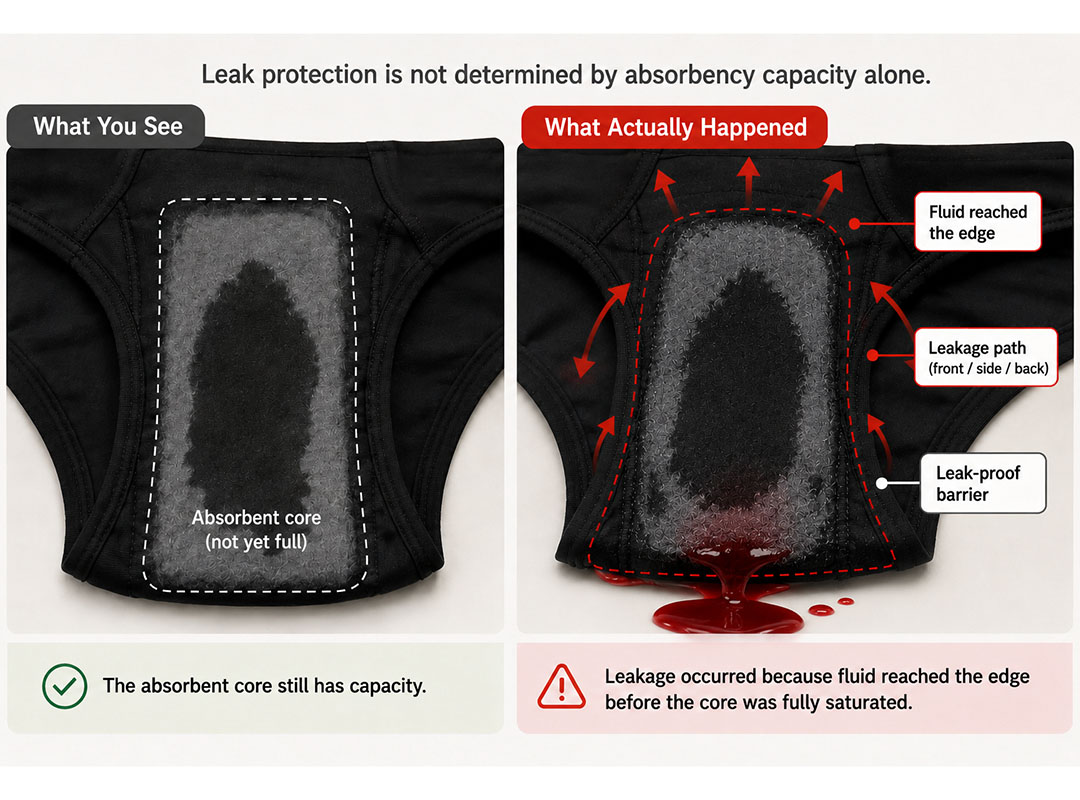
Para marcas en desarrollo ropa interior menstrual de marca propia o de fabricante de equipos originales (OEM)Una de las quejas más frustrantes de los clientes es:
“La ropa interior goteaba, pero la zona absorbente ni siquiera estaba llena.
Si el núcleo absorbente aún tiene capacidad, ¿por qué se produjo la fuga del producto?
La respuesta es sencilla: La protección contra fugas no está determinada únicamente por la capacidad de absorción.
La ropa interior menstrual es un sistema de ingeniería completo. Su rendimiento depende de la rapidez con que se absorbe el líquido, cómo se distribuye, cómo lo retiene el núcleo absorbente, cómo se ajusta la prenda al cuerpo, cómo funciona la barrera impermeable bajo movimiento y compresión, y cómo se mantiene la estructura después de lavados repetidos.
Para marcas en desarrollo ropa interior menstrual de marca propia, ropa interior menstrual personalizada, o trabajar con un Ropa interior menstrual Fabricar o Proveedor OEMEstos factores deben considerarse conjuntamente durante el desarrollo del producto.
Por eso, simplemente añadir más material absorbente no soluciona necesariamente el problema de las fugas.
Corrigiendo un concepto erróneo común
Absorbencia Caespacidad ≠ Protección contra fugas
Uno de los errores más comunes en desarrollo de ropa interior menstrual se está centrando en un dato:
“¿Cuántos mililitros puede absorber?”
La capacidad es importante, pero es solo una parte de la ecuación.
Dos productos pueden tener la misma capacidad teórica, pero uno puede tener fugas antes porque absorbe más lentamente o distribuye el fluido de forma desigual.
En la práctica, el líquido no llega de manera uniforme. El usuario puede sentarse, caminar, hacer ejercicio, dormir o cambiar de posición, lo que provoca que el líquido entre y se mueva a través de la prenda de forma diferente.
Por lo tanto, las marcas que desarrollan ropa interior menstrual absorbente deberían evaluar:
· Velocidad de absorción
· Distribución de fluidos
· Capacidad de retención total
Un producto con alta capacidad pero mala distribución del fluido aún puede tener fugas.
Por esta razón, Ropa interior menstrual de alta absorción personalizada no debe evaluarse únicamente por su capacidad. Es necesario considerar el sistema absorbente completo, incluyendo el Núcleo absorbente, capa que absorbe la humedad, construcción con fuelle y barrera impermeable.
7 mecanismos comunes de fugas en la ropa interior menstrual
1. El fluido puede llegar al borde antes de que el núcleo esté saturado.
Esta es una de las causas de fugas más pasadas por alto en ropa interior menstrual.
Es posible que la parte central del fuelle absorbente aún tenga capacidad sin utilizar, incluso cuando el líquido ya haya alcanzado el borde frontal, lateral o posterior.
En otras palabras:
El producto no está "lleno", pero ya se ha superado la superficie absorbente útil.
El problema suele radicar en la forma y la disposición de la zona absorbente, no en la cantidad de material.
Preste especial atención a:
· Usuarios de alto flujo
· Productos de entrega nocturna
• Personas que duermen de lado
· Usuarios activos
· Flujo repentino o concentrado
Las marcas deberían considerar No solo importa cuánto absorbe el producto, sino también dónde protege.
El ancho, el largo y la cobertura frontal/posterior del refuerzo deben diseñarse de acuerdo con el escenario de uso previsto.
Por ejemplo, ropa interior menstrual de flujo abundante y ropa interior menstrual para la noche Puede requerir una cobertura absorbente diferente a la de los estilos ligeros de uso diario.
2. Una barrera impermeable no evita automáticamente todo tipo de fugas.
Una capa impermeable ayuda, pero no puede bloquear todas las vías de filtración.
El líquido puede escaparse a través de:
· El borde de la zona absorbente
· Costuras laterales
• Puntos de costura o construcción
• Brechas creadas por el movimiento
· Zonas donde el refuerzo pierde contacto con el cuerpo
• Compresión o deformación de la estructura absorbente.
Por lo tanto, la protección contra fugas no se trata solo de elegir una tela impermeable.
El La capa absorbente, la barrera impermeable, el diseño, la confección y el ajuste deben funcionar en conjunto.
Para marcas en desarrollo Ropa interior menstrual a prueba de fugasPor lo tanto, la barrera impermeable debe considerarse como parte de la confección general de la prenda, en lugar de como un material independiente.
La prevención de fugas es, por lo tanto, una problema de diseño a nivel de sistemaNo se trata de un problema de un solo material.
3. El ajuste puede provocar fugas incluso cuando los materiales funcionan correctamente.
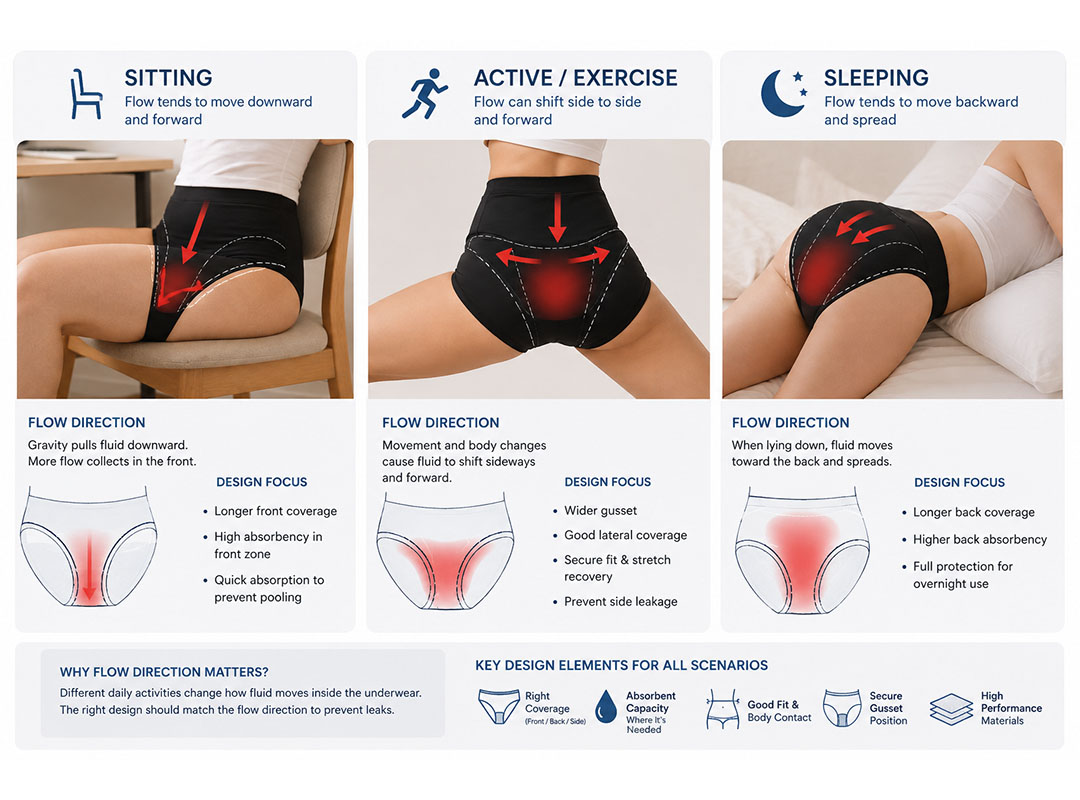
La ropa interior menstrual debe mantener un contacto eficaz con el cuerpo.
Si el fuelle se desplaza o se coloca incorrectamente, el fluido puede moverse lateralmente antes de llegar a la capa absorbente; esto es lo que los consumidores suelen llamar “fuga lateral.”
El ajuste puede cambiar durante:
· Caminando
· Sesión
· Ejercicio
· Durmiendo
• Cambios de posición
Un buen proceso de desarrollo debe tener en cuenta lo siguiente:
Patrón + elasticidad + ancho del fuelle + largo del fuelle + contacto con el cuerpo + movimiento
Incluso los mejores materiales absorbentes no rendirán al máximo si la prenda no se mantiene en el lugar correcto.
Para marcas en desarrollo ropa interior menstrual personalizadaPor lo tanto, el ajuste y el diseño son tan importantes como la selección del material absorbente.
Esto es particularmente importante al desarrollar ropa interior menstrual a prueba de fugas para diferentes formas corporales y rangos de tamaño.
4. La compresión puede cambiar el rendimiento de absorción.
Al sentarse, caminar o moverse, el núcleo absorbente se comprime, lo que cambia la forma en que el fluido entra y se mueve.
Un material que funciona bien en el laboratorio puede comportarse de manera diferente cuando:
· Húmedo
· Comprimido
· Se lleva puesto contra el cuerpo
· Lavado repetidamente
Preste especial atención a:
Ropa interior menstrual ultrafina
· Ropa interior menstrual sin costuras
· Estilos de ropa deportiva
· Productos de alta absorción para uso nocturno
El objetivo no debe ser simplemente añadir más material absorbente.
La pregunta más pertinente es:
¿Cómo podemos mantener una ingesta y retención de líquidos efectivas al tiempo que conservamos el producto fino, flexible y cómodo?
Para marcas de ropa interior menstrual de primera calidad, Este equilibrio entre capacidad de absorción, delgadez y comodidad puede ser un factor importante que diferencie a los productos.
5. El rendimiento de lavado forma parte del rendimiento de fugas.
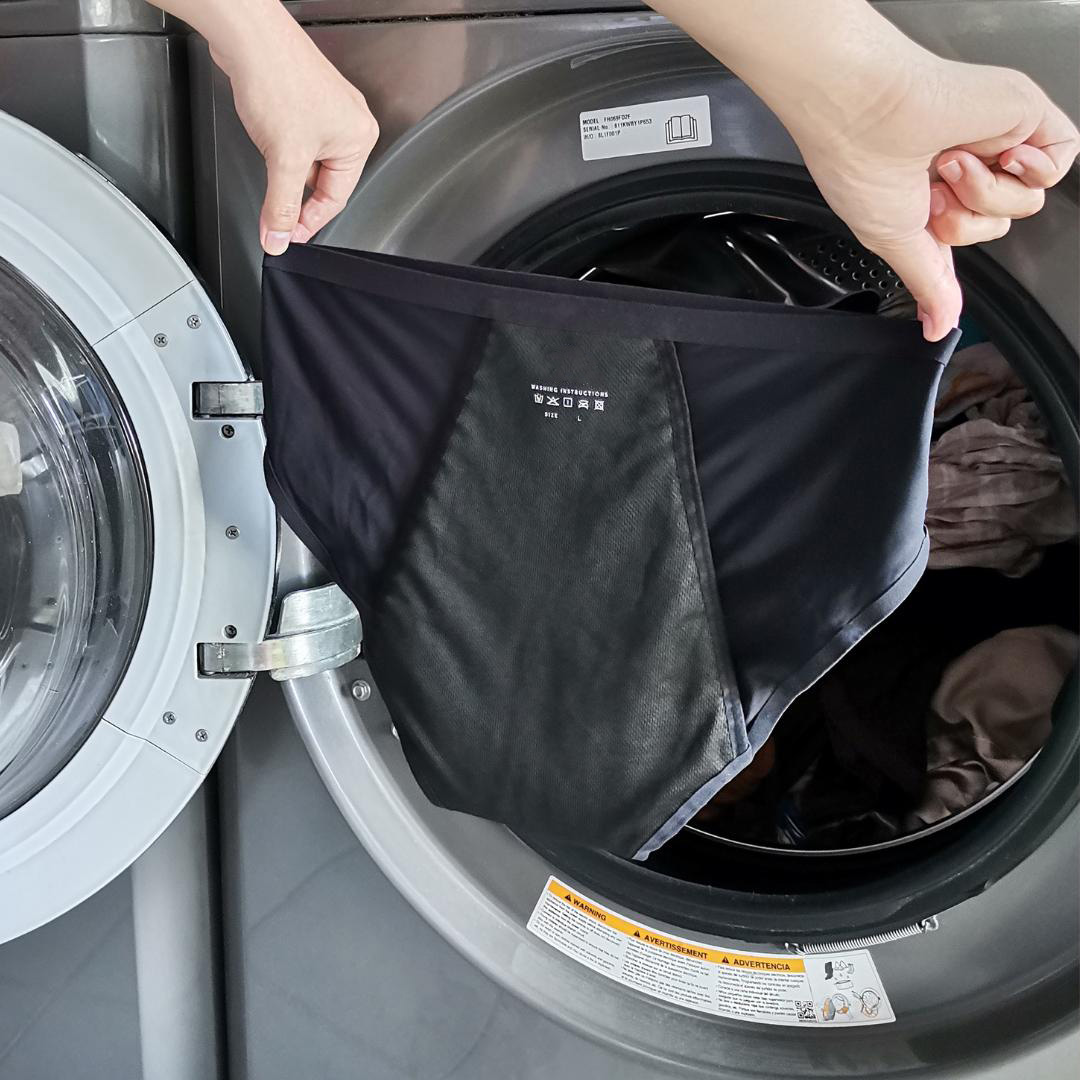
La ropa interior menstrual está diseñada para usarse repetidamente.
Los lavados repetidos pueden afectar a:
· Integridad de la membrana
· Fuerza de unión
· Estabilidad dimensional del tejido
· Recuperación elástica
· Adhesión de capas
· Rendimiento de absorción
· Forma de fuelle
Un producto que funciona bien cuando es nuevo, pero que pierde protección gradualmente después de lavados repetidos.
La verdadera pregunta no es simplemente:
“¿Funciona?”
Es:
¿Sigue funcionando después de un uso repetido?
Por esta razón, el rendimiento del ciclo de lavado debe formar parte del proceso de desarrollo y validación para Ropa interior menstrual lavable.
Para las marcas que desarrollan ropa interior menstrual reutilizable, la durabilidad no es solo una consideración técnica, sino que también forma parte de la experiencia del consumidor y del valor del producto a largo plazo.
6. Por qué “Más capas” no siempre es la mejor solución
Cuando se produce una fuga, añadir otra capa absorbente parece la solución más sencilla.
Pero un mayor número de capas también conlleva las siguientes desventajas:
· Espesor
· Peso
• Tiempo de secado
· Rigidez
· Retención de calor
· Complejidad de la producción
Si la nueva capa añadida no resuelve realmente el problema de las fugas, en lugar de eso, aumentará nuestros costos.
Para la ropa interior menstrual de alta calidad, el objetivo debe ser:
No se trata de alcanzar el máximo grosor, sino de lograr el máximo rendimiento funcional mediante una estructura optimizada.
Esto es muy importante para las marcas en desarrollo Ropa interior menstrual de primera calidad, ropa interior menstrual sin costuras. o modelos ligeros donde los consumidores necesitan tanto protección antifugas como comodidad para el día a día.
Una mejor manera de pensar sobre las fugas de ropa interior menstrual
En CHUANGRONG, no tratamos las fugas como un problema único. Cuando una muestra de desarrollo de ropa interior menstrual tiene fugas, nuestro equipo de I+D En lugar de simplemente añadir más material absorbente, primero hay que analizar dónde se produce la fuga y por qué.
1. Fuga por saturación
Cuando la capa absorbente alcanza su límite práctico de retención, evaluamos la absorbencia, la distribución del fluido y la retención. Para la ropa interior de períodos de flujo abundante, podemos optimizar la combinación de materiales absorbentes o desarrollar una estructura de mayor capacidad.
2. Fugas en los bordes
Si el líquido llega al borde del fuelle antes de que el núcleo absorbente esté completamente saturado, el problema podría ser la cobertura en lugar de la capacidad de absorción.
Analizamos:
Largo del fuelle + ancho + cobertura delantera/trasera + forma de la zona absorbente
Esto es especialmente importante para la ropa interior menstrual nocturna, donde el líquido puede desplazarse hacia adelante o hacia atrás durante el sueño.
3. Fugas laterales
Las fugas laterales pueden producirse cuando el líquido se desplaza lateralmente debido a un ajuste inadecuado, al movimiento o a una cobertura lateral insuficiente.
Para ropa interior menstrual personalizada, Podemos hacer ajustes:
Diseño + ancho del refuerzo + recuperación elástica + mejor ajuste al cuerpo
El objetivo es mantener la zona de protección correctamente posicionada durante los movimientos cotidianos.
4. Absorción lenta
Si el líquido permanece en la superficie o penetra en la capa absorbente con demasiada lentitud, evaluamos la capa de absorción de humedad y el núcleo absorbente.
Una alta capacidad de absorción no siempre significa una rápida velocidad de absorción.. Para Ropa interior menstrual a prueba de fugas, Ambos factores deben funcionar conjuntamente.
5. Fugas relacionadas con la compresión
La compresión puede modificar la forma en que el líquido entra y se mueve a través de la estructura absorbente. Esto es especialmente importante para la ropa interior menstrual ultrafina y sin costuras.
Nosotros optimizar la construcción de la capa para mantener tanto la absorción como la retención controlando bien el espesor.
6. Construcciónn Fugaedad
Si se producen fugas alrededor de juntas, bordes, áreas de unión o transiciones de construcción, revisamos Costura, unión, colocación de membranas y superposición de capas.
7. Fugas de durabilidad
Para ropa interior menstrual lavable, El rendimiento no debe evaluarse únicamente cuando el producto es nuevo.
También evaluamos la capacidad de absorción, la integridad de la barrera impermeable, la adherencia, la estabilidad dimensional y el rendimiento del fuelle después de lavados repetidos.
Del problema de la fuga a la solución de ingeniería
Cuando una muestra presenta fugas, nuestro proceso de desarrollo es el siguiente:
Fugas → Analizar la causa de la falla → Encontrar la causa raíz → Ajustar material / capa / refuerzo / patrón → Volver a probar → Optimizar
Esto ayuda a evitar el error común de añadir más capas sin conocer la causa raíz de la fuga.
Para marcas que buscan una fabricante de ropa interior menstrual, Proveedor OEM de ropa interior menstrual o marca propia de ropa interior menstrual, este enfoque significa lLa protección contra fugas se considera desde la etapa de desarrollo, no después de la producción.
En CHUANGRONG, no solo hacemos ropa interior menstrual más absorbente. Diseñar diferentes estructuras para que la protección sea más fiable en su uso real.
Ya sea que necesite ropa interior menstrual de marca propia, ropa interior menstrual personalizada o fabricación OEM/ODM, CHUANGRONG puede respaldar su proyecto desde la selección de materiales y el muestreo hasta la producción en masa, resolviendo de antemano el riesgo potencial de fugas durante el desarrollo.
Contáctanos para hablar sobre tu proyecto o solicitar muestras, y desarrollemos juntos ropa interior menstrual de mejor rendimiento.
📩 Correo electrónico: Lexie@Sharicca.com
🌐 Sitio web: www.chuangrongapparel.com
ETIQUETAS :